
In this lesson, we’re going to talk about rock and roll piano – well, I guess I should say rock ‘n’ roll, to be official.
This will hopefully be a very simple lesson for you, because rock and roll piano uses some very simple structures.
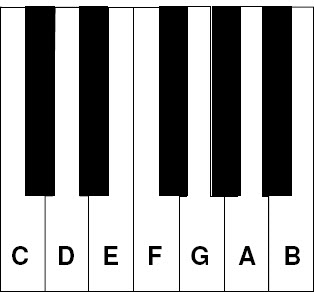
Before we do anything, here’s a picture of the piano keys and note names for your reference. This pattern repeats up and down the piano, so the note names remain the same – they just make higher or lower sounds.
First, let’s talk about the chord progression.
The most standard progression is based on the “12-bar blues” progression:
(4 bars of I) + (2 bars of IV) + (2 bars of I) + (1 bar of V7) + (1 bar of IV) + (2 bars of I)
If you’ll recall from some of my other lessons, the roman numerals correspond to chords based on scale tones. Capital numbers are major chords, and the number corresponds to the scale tone of the chord root.
For example, in the key of C:
I = C major = C-E-G
IV = F major = F-A-C
V7 = G7 = G-B-D-F
Now, let’s talk about each hand separately, then we’ll put them together for the finale, OK?
For the left hand, I suggest starting with one of the following two bass lines:
1-6-5-6
or
1-3-5-6
OK, so what does THAT mean?!
Well, those numbers represent notes in the major scale in whatever key you’re playing.
For example, in the key of C, a C major scale is:
C D E F G A B C
1 2 3 4 5 6 7 8
So, those two bass lines become:
C A G A (moving DOWN from C to A and A to G, then back up to C)
or
C E G A (moving UP the entire time)
For a song that’s “in 4” (4/4 tempo – 4 beats to a measure), simply play this pattern over and over in your left hand.
Got it?
Now, for the right hand…
The easiest thing to play would be the following pattern, depending on the chord being played:
Alternate these two chords over and over for the “C major” portion of the progression:
C-E-G
C-F-A
Each chord should be played at the same time as the left hand. In other words, both hands press the piano keys at the same time:
LH RH
— —
C C-E-G
E C-F-A
G C-E-G
A C-F-A
(This is actually a nice little 2-hand practice pattern)
For the “IV” part of the progression – let’s stick with the key of C for this – play the following 2 chords:
F-A-C
F-Bb-D
while the left hand plays the same pattern as before, but beginning on F:
F-D-C-D
or
F-A-C-D
Finally, for the “V7” portion of the progression, the left hand portion is:
G-E-D-E
or
G-B-D-E
and the right-hand chords are:
G-B-D
G-C-E
The rhythmic pattern is the same throughout this entire progression – simply apply the appropriate chord and bass pattern to each section to build the following chord progression for each measure of 4 beats:
C – C – C – C – F – F – C – C – G7 – F – C – C
It’s kind of like putting together the pieces of a puzzle. In fact, that’s exactly how I think of it when I learn a new tune.
And if you’d like to dive in a little deeper, you might want to check out my Rock and Roll Piano… FAST online/DVD video piano course.
Hope that helps you rock a little harder, or at least easier 😉
Thanks so much for your support on piano playing. I absolutely love piano and want to learn all I can for improvement. Looking forward to just setting down at the piano and going over what you have shared. Thanks, Marlene
Wonderful, Marlene! This past year, I had an experienced “dueling pianist” teach this old dog a few new tricks, so I’ll hopefully be sharing some of those soon, too. 😉
Oh, Bill! I’m a classically-trained pianist and organist and I have always wanted to play jazz. I have taken careful note of each of your lessons but find it all a little bit too much to take in all at once. (It’s probably my age!) I will continue to try, however, and when I have an odd moment I will practise!
It is extremely generous, kind and gracious of you to give these free lessons. If I make some progress I will let you know.
Many thanks.
Mary.
do you have a diagram showing where the notes or letters go on the keyboard.
Yes, I just put a diagram in the post – thanks for the reply!
Sorry, don’t get it. I do not know how to read music, play by ear a bit. would like to learn basic chords and maybe sheet music later. right now what your talking about c-d-e what ever along with strange numbers, do you have pictures of the keyboards telling us where and how to place our fingers per chord. I do have a portable keyboard Casio, its old and has a few instrument banks etc…but I would rather learn the real way…can you help or am I wasting my time!
Sorry about that, Claude. I just included a piano note chart for everyone.
so much to learn, thanks for the help.
Hi Bill: Thank you for all your piano tips. I need you to help me. I accidentilly unsubscribed to yur blog. Please re-instate me…I am getting so much out of your lessons. Thank you…Joyce