Attention, piano players, students and beginners!
Now You Can Sound Like a Pro at the Piano... With a Few Simple
"Building Blocks"
Tired of Playing Notes but not Making Music ?
Read on to discover...
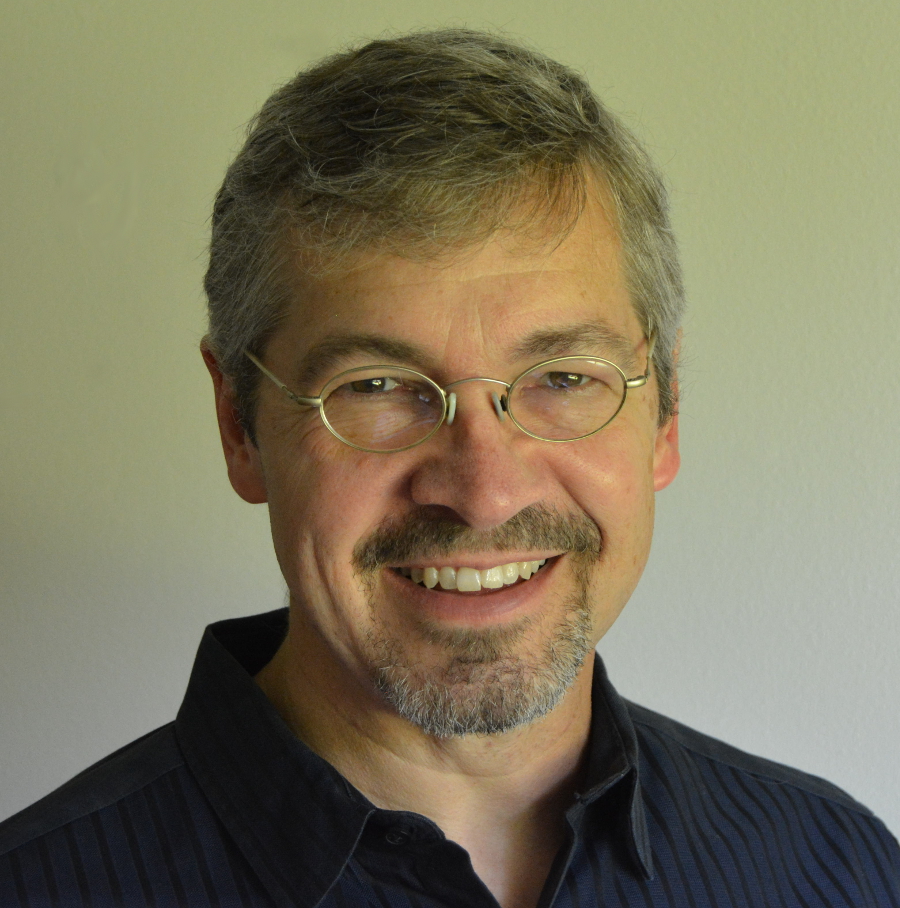
Hi, my name is Bill Romer, founder of PianoFast.
I’ve been creating online piano courses and resources since 2009.
Does It Feel Like Something Is
Missing From Your Piano Playing?
Is making your piano or keyboard “sound good” challenging for you? Are you overwhelmed by all the notes, chords, theory, sheet music and online videos? Does something feel a bit “off” with your playing?
Have you taken lessons in the past, but still can’t seem to make your piano or keyboard sound the way you want it to?
Are you brand new to the piano? Thinking that there’s got to be an easy way to learn songs… without spending a bunch of time and money on traditional lessons?
Did you ever wish you could feel more comfortable at the piano? Or sit down and start playing songs almost effortlessly - even songs you hear for the first time?
I’ve had those very same thoughts and questions many times over the years, ever since I started playing piano around the age of 5.
I'm now a professional piano player. But it took me 20 years to "unlearn" my professional techniques and "install" some very basic building blocks that helped me have more fun and learn songs faster.
I took the long road to get to this feeling of comfort at the piano... Which is good for you, because I can save you all that time and quickly show you what it took me so long to discover. No matter how young or old you are!
Lost in a World of Sheet Music!
It all began when I was 5 years old. My curiosity about our Wurlitzer spinet piano in the dining room got the best of me. I started playing around, asking my Mom - who knew how to play - for help finding notes and reading sheet music.
It wasn’t long before I was playing pretty well for a kid with no formal lessons.
I did take a handful of traditional piano lessons in grade school. But I got frustrated and bored, because I already knew how to play from sheet music. And my Mom and I had quite a collection!
Unfortunately, sheet music became my musical “ball and chain” for the next 15 years. I just didn't know how to learn songs by ear or play different styles off the top of my head.
I Thought Sheet Music Was the Only Way
I Could Learn New Songs on the Piano
(Boy, was I wrong!)
Maybe Studying Jazz and Improvisation
Was the Answer!
Fast forward 15 years and I’m out of grad school with a new job in St. Louis. I've got some new music equipment, thanks to my aerospace job and bachelor lifestyle! LOL
Now I was on a quest to learn how to improvise and play jazz. I found a teacher and studied jazz piano for a couple of years, which was a huge turning point in my musical life. Now I could play rich-sounding chords and make my own arrangements. I bought “fake books” and immediately had thousands of tunes at my fingertips.
I did feel a lot more comfortable at the piano.
Lead sheets have served me well for many years, whether playing solo or group gigs, or for my own enjoyment.
And traditional sheet music is still fantastic. In fact, I rely heavily on sheet music at the church where I’ve been playing for almost 25 years.
But my real discovery wasn’t to come for another 20 years. One simple suggestion from a very unexpected teacher…
I was about to enter a strange and life-changing new world...
A World of Dueling Pianos!
At that point in my life, some crazy notion got me interested in the world of piano bars and “dueling pianos.”
That’s where two piano players face each other on stage, playing and singing every kind of music you can imagine. Oldies, classic rock, disco, rap, country and current top 40 hits. They take requests and play whatever songs they can (they know hundreds).
Sometimes they “cheat” a little and read lyrics and chords from a phone or tablet. But there are actually a couple hundred “core” songs that get requested at almost every gig. “Piano Man,” “Sweet Caroline,” or “Brown Eyed Girl,” to name a few.
I was fortunate to have two amazing musicians teach me this new way to play piano and entertain people. It's an understatement to say that Jason and Christian both made a huge impact on my future musical career.
But I’ll never forget the lesson Christian taught me one night.
I don’t remember exactly how he said it, but he told me to put more emphasis on my left hand.
That’s it.
It’s advice I still use to this day… 15 years later.
I’ve developed many piano courses over the years. And that simple advice made me realize this... you can make any piano music sound great with very simple techniques.
I call them “piano building blocks”... a handful of almost stupidly simple techniques that can get anyone up and running - or sounding better - on the piano in practically no time.
You'll end that “stuck” feeling when you sit down at the piano.
Even if you don’t have a particular song in mind, you’ll always have something to play - a musical “base” to start from.
Eliminate "online overwhelm." You’ll have a specific set of tools to create your own arrangement for just about any song.
These building blocks can change the way you learn new songs and the way you feel about piano.
The real “secret” to learning songs on the piano is to break them down into basic elements and build up from there. Just make sure each element sounds good. That goes for melody lines, chords, left hand bass, where to play particular notes and chords on the piano, and so on.
Here Are Some Encouraging Piano Facts...
Take a look at this chart created by Kenny Nin, a Spotify data analyst. It shows how often each key appears in all the music on Spotify. Notice that just 7 (30%) of all 24 keys (major and minor) appear in over 50% of all their music.
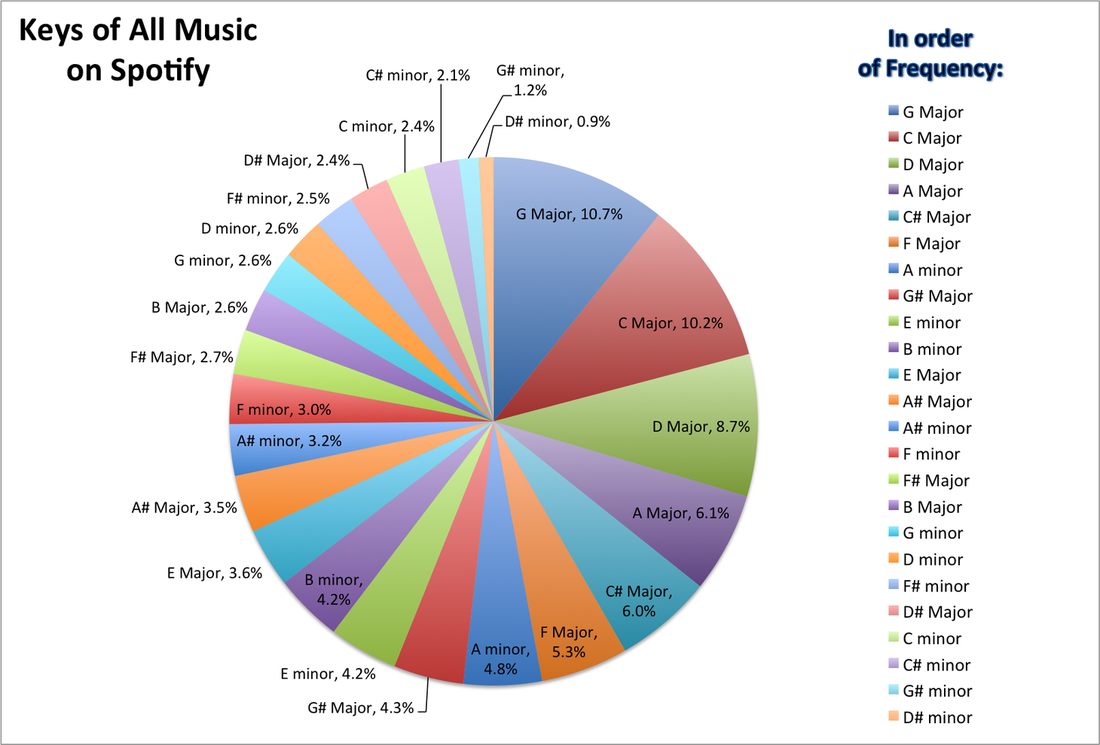
Chart by Spotify data analyst Kenny Nin
And here's another surprising fact... A tremendous number of popular songs use a progression containing just 4 chords. In Roman numeral notation, they are the I, IV, V and vi chords. In the key of C, that would be the C major, F major, G major and A minor chords.
So, you don’t need to learn every single chord or every key to play many of your favorite songs on the piano. You can get a lot of mileage from some very simple beginnings.
Build Your "Piano House" on the Rock...
or a Few Big Rocks
A great house starts with a strong, solid foundation. The same is true for your "piano house," and I can assure you that these building blocks are truly the rock-solid foundation you need to create simple, great-sounding arrangements on the piano.
And using these building blocks is truly the most efficient way to jump in and play your favorite songs... without spending years or thousands of dollars on traditional piano lessons.
In fact, these are the exact techniques I use to learn a new song - while on a gig - in 5-7 minutes. Mind you, I’m not able to do this with every song, but it sure comes in handy sometimes.
And don’t worry… you don’t have to learn songs in 5-7 minutes, like I sometimes do. I just wanted to give you an idea how powerful and useful these techniques can be.
Now, I don’t have anything against traditional piano lessons. They can be very helpful, especially if you plan on studying piano in school, or becoming a piano teacher. Maybe you want to learn everything you can about this beautiful instrument.
But if what you really want to do is sit down and start learning songs and playing quickly - for fun, for yourself or with family or friends - these piano building blocks will get you up to speed fast.
With the confidence and feeling of accomplishment you'll get from your improved piano skills, you can always add on the "fancy stuff" later. But these building blocks can be the foundation of your playing for the rest of your life.
That's Why I Created an Entire Course About It...
Introducing: Building-Block Piano
Whether you’re a beginning pianist... or you've had a few lessons… or you're playing regular gigs...
It’s never too late to fill your “piano toolbox” with a handful of powerful building blocks that can help you now and for the rest of your piano-playing life.
With immediate access to online videos and downloadable PDF resources, you’ll have the professional tips and techniques you need to create a solid playing foundation and increased sense of comfort at the piano.
Here's What You'll Learn
Left-Hand Techniques
Right-Hand Techniques
Creating a Minimum Viable Arrangement (MVA)
Something for Every Skill Level
Every lesson in every module is presented in a unique, 3-part format. Each concept is presented three different times... for beginning, intermediate and advanced piano players. You can start with the beginner lesson and move on up to whatever level feels most comfortable for you. Heck, even advanced players may learn a few tricks from the beginner lessons!
With over-my-shoulder video format, you can see my hands at the keyboard and exactly which fingerings I use. A graphical keyboard just above that lights up each note on the keyboard as I play it. You’ll always know exactly what I’m doing.
You’ll have immediate access to the course - forever - so you can get started and work completely at your own pace. Watch on whatever device you like - laptop, tablet, or phone - and stop, start and rewind videos to your heart’s content.
I’ll even show you some unique practice techniques that are scientifically proven to help you learn songs faster and retain concepts longer.
But This Course Is NOT for Everyone
Non-Traditional
If you’re looking for a traditional piano course to teach you how to read piano music formatted on a grand staff (treble and bass clef), this course is not for you.
Not a "Method"
This course does not follow the old “book1, book2, etc.” format of those courses you might remember from private piano lessons. We’re going to jump right in and jump around to different topics. The order will make sense - but the goal is to get you familiar with this set of piano power tools as quickly as possible.
No Powdered Wigs!
One more thing… This is not a classical piano course. If you’d like to learn to play Beethoven or Mozart, you should look elsewhere.
What Students Say About My Courses
❝
Your information, together with your follow-up program is the best I have seen in terms of communicating how music works, especially to those who are intimidated by notes, staffs, clefs, rests, etc. In my case, I have always been able to "hear" the chords I wanted - now that I have your book, I am able to play most of them as well.
Richard Narrell
❝
I have bought several courses from Bill and all of them have helped me understand the basics of playing. I was sold on Bill Romer. His instruction his great. He doesn't look down on his students. He lifts them up and encourages their progress. The times I have had questions I got a quick response from Bill. I believe the greatest achievement has been the increase in my self-confidence.
Jim Free
❝
Your attention to detail, the thoughtful way you approach displaying your work, including your wise use of technology, is why I chose you.
Gary Guy
❝
Chords have stopped intimidating me. I see patterns and they come naturally. [There's] a long list of benefits which came out of signing on with you, Bill.
Bob Worthing
Right Now, You Might be Thinking...
This is going to be too expensive.
Consider this… private piano lessons cost anywhere from $40 to $80 per hour. That makes this course worth several times the modest enrollment fee. And most private lessons don't give you forever access to recordings of the lessons!
I don't have time.
This course is designed for you to work at your own pace, whenever and wherever you like. It only takes 5-15 minutes a day of focus and a little practice to immediately start improving your piano playing.
Sheet music is complicated.
That's why I use very little (and sometimes none) of it in this course! It's all about teaching you the simple techniques you can use to build a piano arrangement quickly... either from listening to a song, or using a lead sheet (one melody line with chord symbols above).
I took lessons, but they didn't help.
Most piano teachers will not teach you the techniques and tricks in this course. It's not their fault, and there's no "piano teacher conspiracy" going on! They’re just conditioned to teach you "traditional piano lessons" the way almost everyone has for hundreds of years.
My goal is different... I'll show you how to create your own quick piano arrangements of your favorite music in a way that is simple to understand and implement and that sounds professional.
BONUSES
Building-Block Piano will help you quickly take your piano playing to the next level,
and these bonuses will really help you lock in your new piano skills!
Bonus 1#:
"Music-less" Chord and Scale Charts
In case you don't have my famous chord chart already, this monster chord reference shows you - visually, with no sheet music - how to play 31 chord variations in every single key. That's 372 chords!
You'll also have access to the complete scale chart from my Piano Scales... FAST! course, so you'll never be left wondering how to play a particular scale or chord.
Bonus #2:
Online Piano Chord "Calculator"
Imagine being able to type virtually any chord symbol into a web page, and colored squares appear on the keys of a piano to show you exactly how to play that chord! That's exactly what my amazing little piano chord "calculator" does for you.
From basic to advanced chords, just type it in, and you'll see the notes that make up that chord. You'll probably want to change the voicing a bit, or maybe leave a few notes out, but this nifty little calculator will certainly get you off on the right foot (or hand!).
Bonus #3:
"Danny Boy" Video Piano Lesson
This video and lead sheet combination will show you how to create a beautiful arrangement of the Irish classic, "Danny Boy."
You'll also learn how to use the most well-known chord progressions to create professional sounds from a relatively simple little song.
Check it out before you start Building-Block Piano... or once you get a few modules into the course.
A Few More Student Comments...
❝
I have taken other online courses - they are good and helpful but yours are more personable. I like it because it seems you're talking to me and not just anyone who bought the course.
John Iabone
❝
Finding you on the internet was the greatest piano blessing that I have discovered. Purchasing your product is the BEST MUSICAL INVESTMENT that I have spent my money on in the last 3 years. And believe me... Over the past 3 years I have invested literally thousands of dollars in CD's, Tapes, Books, Music Lessons. Your program has regenerated my enthusiasm and has uplifted my spirits and given me great encouragement.
Tony Willis
❝
The way you explain things keeps me motivated to learn and be the best I can be.
Mike A.
❝
I have been looking for 40 years to learn what you showed me in 30 min. I have no words to tell you what this means to me.
Don Mallory
The True Value of this Training... and Your Time...
I have literally spent years of my life and $1000's of dollars of my own money learning the techniques I share with you in Building-Block Piano. In fact, the lessons in this course are roughly the equivalent of 6 months of traditional private piano lessons.
Especially when you consider that you usually need multiple traditional piano lessons to really learn new skills.
But with Building-Block Piano, you can watch each lesson over and over as many times as you like… without having to pay for another lesson!
And when you add in the bonus resources and lessons, the true value of Building-Block Piano is certainly over $1000.
But I created this course to help as many people as I can - piano players just like you - experience the same transformation I did in a much shorter amount of time.
That's why I'm making Building-Block Piano available during this open enrollment period for a very special price.
Enrollment Closed
Enrollment for Building-Block Piano is currently closed. Enter your name and email address below to be added to the waiting list and be the first to know when we offer the course again.
Bill Romer
Creator of
Building-Block Piano
About Your Instructor
I've been playing piano for over 45 years, ever since I was old enough to sit down at my Mom's Wurlitzer spinet and ask for help sight-reading her stacks of old sheet music. For the past 30+ years, I've played piano professionally for parties, weddings, receptions, funerals, masses, festivals, ball games... you name it.
For the past 13 years, I’ve been helping thousands of pianists - beginner through advanced - all over the world. With my YouTube videos, free piano chord charts, and “lead sheet breakdowns” of popular songs, I’ve had the privilege of helping "everyday" pianists take their playing to the next level and even experience an “aha” moment or two along the way!
30-Day Money-Back
100% Satisfaction Guarantee
I’m so confident that you’ll love Building-Block Piano that I back it up with a 30-day, no-questions-asked money-back guarantee. If you’re not completely satisfied, just shoot us a message through our support desk and we’ll issue you a prompt, no-fuss refund. That means you can try out Building-Block Piano with absolutely no risk!
The Choice is Yours
Because of the time and technical effort required to maintain this course, and in order to give personal attention to students, I’ll only be accepting new enrollments for the next few days.
So if you want to make serious progress with your piano playing and significantly increase your comfort level at the keyboard, without spending a ton of money and time on traditional piano lessons, then I invite you to enroll in Building-Block Piano today.
If you’re completely happy with your current piano abilities and feel there’s no room for improvement, then, frankly, this course is probably not for you.
If you plan on piecing together piano lessons from various sources - offline or online - and hoping it will all click at some point, then I suggest you keep looking elsewhere.
But if you’ll spend just a few short hours with me, learning the piano secrets it took me over 40 years to finally locate, and if you put in just a little bit of regular practice time that I suggest, I guarantee you’ll come away a better, more comfortable piano player.
In fact, since you’re protected by my 30-day money-back guarantee, you have absolutely no risk!
Frequently Asked Questions
Do I have to complete the course in a certain amount of time?
Can I download the videos to watch them offline?
Can I get help if I'm having difficulty with something?
Do I need a real piano to benefit from this course?
How long will I have access to the course?
Copyright © 2022 - PianoFast